Tuesday, November 26, 2013

Taupo Tapout III - part 1

Just back from an intense weekend of polo and craziness in Taupo.

Photos will hopefully come soon, but here is my first claim to fame:
Goalhole drawing by Patrick about Martin's snoring

Tuesday, February 26, 2013

Wheelchair Bike Build Notes

In response to a couple of questions, here are some notes on how we built the wheelchair bike a few years back.  Bon chance to everybody trying their hand at creative solutions for family and friends.

Goals

  • Make wheelchair trips using the power of a bicycle drivetrain.
  • Keep our heads close enough together to talk.
  • Use the existing wheelchair we had.
  • Retain the ability to fold the wheelchair for car-based trips.
  • Attach/Detach fairly quickly.

Early Concept


The overall design was modelled off old rickshaws.  The tadpole design (with the two wheels in front) means that the cyclist's head come forwards towards the seated person's head and conversation is feasible.  This contrasts strongly with the alternative where the wheelchair is towed behind and the occupant feels very distant.

As you can see, my first thought was to retain the bicycle handlebars and clip the bike forks onto some sort of axle placed between the wheels of the chair.  The axle had to be unreasonably high, however, and I wasn't sure how to build a simple and strong attachment for the forks.  Once I decided to modify the bike parts, I moved towards having the steering pivot in line with the wheel hubs.

You can also see that using blocks I was able to set up the tilt angle of the wheelchair to find the balance between feeling upright and raising the front wheels enough to avoid bumps and to get up driveways.

Planning the Back Half

The easiest way to draw up a plan was to cut up the donor bike, lay the parts out, and trace everything out life sized.  Then I drew in straight lines to connect the parts, to represent new tubing.

Note that I turned the steering tube upside down as the angles of the tubes coming from it matched the design better that way.  This required swapping over the bearing races from top and bottom, which would have been hard without access to my uncle's hydraulic press to reseat them.  This could probably have been avoided.

It is essential to try and position yourself amongst the parts.  This photo reveals one of the big problems in the finished product - the wheelchair handles are too near my knees.  The layout pictured wasn't the final plan, but sadly I failed to adjust sufficiently.

Welding

With much help from a welding nightclass, I was able to put the frame together.  My tutor did the bending in the lower left of the photo, which was a bit complex for me.

I didn't have a proper jig for setting up the welds, and didn't get the top tube on the the same plane as the seat tube, resulting in a small list to the left.  The result is tolerable, however.

Attachment to the Wheelchair

My uncle, an engineer, made this actually work for me.  I brought him the rough idea and he did the important machining and welding.  There are more moving parts and adjustability than I would or could have made myself.
  1. A baseplate clamped to the frame on each side
    We started by making a surface on each side to which we could attach the crosspieces.  The plates are just squares of mild steel, a couple mm thick.  We didn't want to weaken the wheelchair by welding it, so everything can be detached.  We made clamps to attach each plate at two points on the lower horizontal rail, and the wheel axle had enough extra thread for a third point of attachment.

  2. Steering tube
    As mentioned above, our tube was turned upside down so we swapped the bearing races.  We cut down the existing forks and used them to connect upper and lower cross pieces.  The lower cross-piece was welded directly to the fork, but since the top of the fork was just a threaded tube we manufactured a new 'nut' to thread on the top.
    My uncle made it a double ring, with the threaded nut to secure the fork/bearings and an outer ring which could rotate until the set-screws are tightened.  This allowed rotational adjustment of the upper cross-piece, reducing by one the number of things we had to get just right when we welded those last parts.

  3. Cross pieces
    The lower cross-piece was just a square-section tube with steel across each end into which we drilled and threaded a hole for the hardened bolts I bought at the local auto shop.  We drilled matching (but unthreaded so slightly wider) holes into a couple short lengths of steel which we attached to each end and then tack-welded to the plates after positioning the steering tube and ensuring it was central and vertical.
    For the upper cross pieces we made the end pieces first and bolted them to the plates.  Then we fitted the cross-pieces on each side and tack-welded them at the sides and centre.   Apparently there was some risk of deformation with all the final welding, so we did it in short spurts and things still fit reasonably well.

Brakes

You don't want a bike, particularly not a heavy one, without brakes.  The wheelchair only had lock-on brakes, which weren't good enough.  I would have liked disc brakes, but couldn't see how to do that.  What I did have was lots of old caliper brakes from 10-speeds, which I found fitted okay once I increased the spacing between the wheel and the (black) push-rim.  

The first photo shows them attached to a cross-bar which runs right across the chair, but since this prevented folding I welded on a vertical piece and gained a second attachment point.  Rough, but ready.   

To pull the breaks I put some old mtb levers on the wheelchair handles.  These are great when walking the chair down slopes, too - much nicer to squeeze the hands than lean back against the momentum of the chair.


Final Results

A few last pictures for you.  Since all the special bits were detachable from the wheelchair it was easy to take them off and paint them a cheery yellow.  The leftover paint served for the altered sections of the rear frame and the connectors.


I find that it takes a couple of minutes to bolt or unbolt - slightly longer when I'm out of practise.  I added SPD pedals, because you want any extra power you can get on hills.  As mentioned, the posture is a bit bent over and there is that slight list to the left, but for a first crack we've been very happy.

Another thing to mention is a seatbelt.  We got a simple lap belt for Heather to use so she doesn't fall out if we hit a bump.  It is scary enough facing traffic from that open front seat, so the psychological benefit is also important.

Gears

One thing I haven't mentioned is gearing.  I have cables and levers for both the front and rear gears, but have never found a good way to mount them.  In practise, I crash between top and bottom on the rear cluster, and never change from the smallest front ring.  Not sure what I'll do about that.


That's all for now. Hope it inspires you and helps with some practical details.

Martin.

Saturday, September 15, 2012

Poverty Cycle 2012 Ride Report

What a day for a bike ride!  The rain held off until we'd packed up, but the wind was strong from the get-go and disrupted both the riders and the supporters.  I only rode 40k, but considerably faster than I would normally ride into such a wind. (Actually, I would change my schedule if possible.)   By the time I got home and had a long bath my body feels fine, but I have no oomph and my legs feel particularly empty.  Curiously, my most troubled body parts are my eyes and sockets - they feel very dry and windblasted.

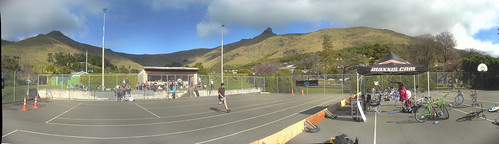
The picture below shows the start/finish area, and should feature a line of gazebos on the far side where the supporters are clustered.  They were already up when we arrived at 7; we were fixing one at 7:30, and and 9 they were taken down after two had been written off.


Today was the Poverty Cycle, a charity ride that my work is trying to establish.  Last year we trialled a family-fun-day model, but this year went with a corporate challenge format.  Teams of 5, racing nine rider-laps of a 20km course with no more than two riders going at any one time.  Most of the course was flat, but there was a big hill about 3/4 of the way round.

My team did not win.  By the time we finished our 8th lap (4 pairs), prize-giving had already started and our final rider couldn't see the point.  Everybody had at least one lap, though.

The winning team was a bit more committed:  by 7:15am (for an 8:30 start) they were on the trainers in a stall beside the parking area and out of the wind.  They smoked everybody, averaging 35 minutes/lap.


I rode in the 2nd and 4th pairs.  First up I paired with Richard, Doesn't he look like the boss and me the working man in my coarse woollen suit?  I picked the suit up from the Sallies in Te Aroha, two weeks ago, for just $15.  Couldn't resist, and I expected that Richard would be in street clothes since he is already riding around to appointments dressed like that.


One good thing about the weather - it helped keep us cool.  I changed to my everyday road helmet for my second time round, which had much better airflow (but is boring black).

Richard was running aero bars, and kindly pulled me around the track.  He is a much stronger rider than me, probably due to commuting up a nasty hill every morning, so even leading into the wind his pace was all I could handle.  The one time I took over, in a sheltered spot, I misjudged and sapped my energy just before the big hill climb.  I actually felt better and better going up the hill, as my system caught up on itself.

The most exciting part of the ride came right at the end of the first lap.  We turned into the start/finish area, and two of those sign holders (behind us in the photo above) blew across our path!  Thankfully far enough ahead to avoid quite easily, but it did start the heart pounding.

Second time round was a bit hard at first, after eating a couple croissants and standing in the wind for ages, but the flat sections were actually easier overall.  Franck (pictured below with the person I entrusted my camera to) set a pace better matched to mine, then dropped me on the hill where I didn't have much left in my tank.  I shamelessly drafted most of the way again, as he never tucked in behind when I was leading - why do that work for somebody who doesn't appreciate it?


I'm pretty knackered tonight, but it has been a good day.  I can't see myself taking up racing, but I might give it a go again next year.  My friends chipped in $520 for anti-trafficking work in Nepal, so I'm pretty pleased about that.  Thanks to everybody who sponsored me.

Hope this blog isn't too meandering - brain fog is closing in.  Off to bed now.

Friday, August 5, 2011

Bike Pride and the Wynyard Quarter

Was tickled to show the Yuba off to David Haywood and whanau on they way out of the Orcon Great Blend last night. Apparently they've considered a cargo bike with two child seats. Hope I restrained my enthusiasm below the boring fanatic threshold.

Then cycled through the Wynyard Quarter due to open tomorrow. Nice spaces, and a handy ramp up to the viewing platform. That nice existing frontage around half the Viaduct Basin will hopefully connect right around (timeline suggests 2013?) and should benefit from having more outdoor punters in the area rather than the restaurant/bar clientele of the Viaduct. Speaking of which, the bridge provides nice pedestrian access between Wynyard and the Viaduct which could change the dynamic of the whole area.

Got several comments appreciating the bike lights as I cruised around, but uncertain how much to value the opinion of the guys peeing off the wharf.

Monday, April 11, 2011

Now it's getting hard - FY2011 Carbon Accounts

Our pollution figures for this year have increased a long way back towards their 2007 levels. Major contributors were my trip to Christchurch for a polo tournament and the purchase of a new laptop.
Looking ahead, we have decided to set a target of reaching the current1 globally sustainable per capita emissions level (~1.2T CO2e) by 2050. This requires us to reduce by just over 3% each year, compounding. That will become increasingly challenging, and require systemic change2 around us as well as personal lifestyle choices.

For the new year, we plan to find 2% by halving our regular butter and sugar consumption. These are mostly used for baking, for which we will increasingly use margarine. We are testing various recipes with less sugar, and may alter our selection of baked treats. As a side benefit, this could be healthier.3

We want to make the remaining 1% savings amongst our "irregular" consumption: rarely taken actions or supplies for special occassions. These are the source of all variation recorded between this year and last, as we haven't performed a new baseline audit and continue to use our 2010 figures. The very irregularity of this consumption makes it harder to work with. Over time we will expect continuing fluctuation, but require an underlying downward trend.

Accurately reporting this will require an improvement in our accounting practise. A likely first step will be to amortise the big figures, a practise we have so far applied only to the house. Our new laptop will be used over several years, but we thought there would be enough similar items from year to year to smooth out. That will be less and less the case as we make smarter purchases.4 We may also plan to fly domestically once every n years, rather than on a most-years basis, and budget that into our regular baseline.

__________
1) With world population expected to rise to perhaps 9 billion by 2050, the per capita sustainable emissions level will presumably decrease.
2) 20% of our current emissions are due to public services we have no direct choice about consuming. Yesterday Heather initiated conversation with a Dunedin city councillor on this very topic, building on a hint of shared interest.
3) Going significantly dairy free would make a much bigger impact on the carbon numbers, as well as distance us from an industry which has recently expanded beyond the country's carrying capacity. We remain held back by uncertainty over how to supply Heather's calcium needs and reluctance to overhaul the complex dietary system we have developed for her over eight years of illness.
4) The laptop also stands out because we bought it new, rather than second hand. We have chosen to assign all emissions responsibility to the initial (retail) purchaser, so the choice between new and second-hand is much more stark in carbon terms than dollar terms. We could change this policy, at least on large items, which would be more accurate in many ways but opens the thorny question of how to apply depreciation.

Monday, February 21, 2011

Beach! Beach! Beach!

Which one needs the wheelchair?

Yesterday we went to the beach to try out something new - the Vera Wansbrough Memorial Beach Wheelchair. The chair has fat, low pressure wheels to glide over the grass and sand right into the water. The goal was to get Heather to the water more often, which seemed a fitting use for some money inherited from her beach-loving grandmother.

The chair was a great success, and will be well worth the money (approx $600) if we get out a few more times each summer. No more parking the normal chair where the path ends and carrying Heather across the sand into the water. No more carrying her back up, all slippery and wet.

In the future we won't take the other wheelchair, but took it just in case yesterday. It did provide a nice place to sit and talk to Heather, while she reclined in her personal lounger.

The wheels also make a handy seat.

With its big wheels, the whole contraption floats when nobody is sitting in it. With a person sitting in it, the wheels still float but the foot end gradually sinks. We hope that a simple floatation device strapped on that end will give us a fully floating option that Heather can swim on and off.

The following video shows how smooth the process of coming out of the water was. If you're wondering why we pause, back up, and move forward again, that's me discovering where the floating wheels touch bottom and start turning. I also stop to check if it works to push from the head end, but decide that it works best to pull from the feet. We do need a handle to save stooping over and avoid lifting too high and banging poor Heather's head.

MUTE BEFORE WATCHING - NASTY STATIC


Do try this at home. Our system is cobbled together from a pair of 49cm Wheeleez Wheels (distributed in NZ by BeachWheels.co.nz) and a $50 fold-out beach lounger we were given several years ago. We bought an axle and locking pins with the wheels, and ran the axle through a piece of hdpe pipe I had around the house (it was too small for making polo mallets). Two hose clamps were also required. Here are all the parts:


The pipe is simply lashed to the mid-section of the lounger, using hemp string. I had to use a needle to thread the string through the plastic canvas, to get the axle at a suitable balance point.


Using the pre-fab lounger saved heaps of effort putting the canvas onto a frame, but it was never designed to go into salt water and will presumably be replaced in time. By then it will have earned an honourable place in history for proving out the idea.

The frame was designed to have a support under the knee, which doesn't work when it is being lifted and the force goes the other way. To stop the lounger folding up at that point I put the hose clamps on to hold the two tubes together. The clamps loosen with a screwdriver and slide off the end of the the lower tube, allowing the lounger to fold again for transport. So far it is working, but you can see that the previous (pivoting) attachment between those tubes has been strained during testing. I think that the strain has eased since I moved the axle, but only time will tell.


Net result: one very happy Heather.

Thursday, October 21, 2010

Did I make it to Christchurch?

Yes. And wasn't the weather beautiful!


So it's been almost 3 months, but here's my report for the record from the polo comp in Christchurch.

Winter Whack - 3rd Place Winners!

Our team started out with a good couple of wins, but couldn't sustain the intensity and got wasted by in 3 minutes flat by the eventual champs - Polo Disco. In the 2nd/3rd playoff we put up stiffer resistance, but eventually the same team which twice beat our fellow Aucklanders put paid to us as well. Props to Glenn who sorted out the Auckland teams - he must of done a good job of balancing us up as we came out 3rd and 4th at the end of the day.

Play was pretty intense at times - you had to commit the body right up to the action, which resulted in a bunch of spills. At one point I lost my rear brake in our first game, and eventually traded the bike off for Glenn's. Playing so many games at that intensity did take it's toll, and I reckon that was a factor in the later games. Polo Disco was clearly a cut above us in skill as well. Not just us, as they swept up the entire field pretty handily. I think they had 3 goals scored against them all day, but thankfully nobody enforced the down-trou rule or there'd have been a lot of flesh on display.

The whole tournament had a great atmosphere, and everybody seemed to have fun. There was quite a range of skill levels, with people drawn in to make up teams or whole teams of occasional players. No way could Auckland have fielded 21 players like Christchurch did, but hopefully a return tourney will pull out a few of our potential/interested people.

Everybody's first question on arrival was why there were so many vegans in the Auckland delegation. The Chch crew is based around fathers who can't get out for mountain-biking like they used to, whereas I can't think of any player from Akl who has kids. Very different demographics didn't hinder us enjoying a night at the pub together beforehand and an aftermatch dinner at the Dux (which has several vegan options).

One last thing to point out - the club house next to the courts is a great idea. It allows them to store edging for the court, rather than losing the ball under the raggedy fence edge or digging it out of weedy gutters. We need something like that in Akl.

Cycle Friendly City

Christchurch was truly fabulous to cycle in. Lots of cycle lanes. Nary a hill through much of the city. A beautiful park with good tracks to ride through. Most importantly - lots of other cyclists to keep the drivers in the habit of looking and waiting.

They also allow bikes on buses, and I went 30kms out to Rangiora for $5.80 each way to visit a colleague. Get off at the other end with your bike, cycle to a store to pick up a drink and choccies, and find your mate's house. So much harder on foot. But do allow for the fact that the first bus after school gets out may have a full rack.

So thanks, Christchurch! Thanks to Craig for being the main man behind the tournament, and thanks to Mads and Malcs for putting me up and feeding me lots of warm, scrummy soup. (I did get sunburnt on the big day, but it wasn't always warm down there.)

Enough from me. Check out more photos from the day.

Tuesday, August 31, 2010

Long Way to Work

For probably the first time in my life, I took the scenic route to work today.

It's been a very rainy spring, but the sunny gaps are lengthening and I found myself in one this morning. On top of that, I was on the fixie for the first time after weeks of carting the laptop backwards and forwards (which tips the balance to the Yuba). Riding a light bike, in the sunshine, with nothing urgent waiting in the office, it just felt right to breeze past a turn-off and go a couple extra blocks.

Happy.

Friday, August 13, 2010

En Route to CHCH

Greetings from Auckland Airport, where I'm waiting for a delayed flight.  I left home at 06:45, arrived at the airport just on 0800, an hour early, and discovered that I'd left my passport at home! :-(  To add insult to injury the slowly-dying cellphone had another fit, but eventually I got hold of poor Heather who arranged for a friend (thanks, Chris) to drop the wallet off for me.  Not really what she needed just before I went away for 5 days and left her with much more self-care work than usual.  Poverty is having nobody to turn to, eh!

Anywho, turns out you can check in without the wallet so I bagged the bike and had no trouble checking that in.  Then I got the wallet and commenced waiting again.  Plenty of time to look forward to a fun weekend, and getting our butts kicked at the polo comp.

Friday, July 23, 2010

Environmental Footprints 2010 Tax Year - Encouraging Results

Good news! As best we can measure, Heather and I have reduced our CO2 footprint to 30% below the global average. This is a sizeable step1 towards the 40% rich-world reduction which groups like Oxfam are calling for by 2020, a supposedly unreachable target which will 'destroy the economy'. We were encouraged how close we were with 10 years to go, after only moderate changes. No "extreme" measures like detaching from the grid or composting toilets.

Remember, though: we still need 3 planets to absord the carbon emitted if everybody on earth lived like us. Let's not get too self-congratulatory.

Heather and I are constrained to a quiet life by her health, but it's still a distinctly Kiwi lifestyle and we enjoy the benefits of living in a wealthy country. We have made choices to constrain 'expenditure' which gave low return on investment, so that we have plenty to put into activities which bring abundant enjoyment.

Our lifestyle is specific to ourselves, and features several elements that will be particularly difficult for some. For example, we have found work, friends and shops close to home which eases the choice to cycle. Others may find that choice harder until they move house, but over time more walkable (and cycleable) communities will emerge. We also utilise interim practises like buying second-hand, which clearly don't work if everybody tries to do them. These represent further problems to solve, and of course there are plenty of things (like raising kids) that we just don't do. Nonetheless, we are encouraged by the progress we have made and feel confident that others will be making progress on those other challenges.

One challenge all Kiwis face is that public services cost 840kg CO2e/person/year. That represents 2/3 of the globally sustainable per-capita level (2010 population), before we make any direct personal consumption choices. Fully 1/2 this figure comes from building and maintaining roads!


All this thinking comes from the environmental footprint data for the two of us which hardworking Heather has again compiled. She put them together from a detailed 3 month audit and ongoing tracking of unusual consumption items. This data was primarily recorded to calculate a Greenhouse Gas footprint, but she has worked to extract additional estimates from the data.

There is also a year-to-year comparison of our CO2 figures, with retrospective adjustments for new factors added to our audit spreadsheet in the last year. The graph clearly shows the impact of my flying to China in late 2008 (2009 tax year). Something to chew on as I consider flying to Christchurch next month for a cycle polo tournament, which would cost 0.6T -- 15% of my 2010 total emissions.

See the main report for details, graphs and comments, but here are the key numbers as multiples of the sustainable global average footprint
  • CO2e - 3
  • Fresh Water (crops) - 1.43
  • Fresh Water (industrial) - 1.08
  • Agricultural Land - 0.7

  • Forest Land - 0.04
  • Fisheries - 9
Those last two numbers are separated out because they are quite sketchy: the Forest Land number fails to account for the wood used to build our house, and the appropriate baseline for comparison for Fisheries is unclear.

About the fish, I can say that Heather eats a moderate amount of tin fish for health reasons but our fish sauce use is the biggest contributor to that number. We were surprised to find that, and are looking into whether this is an artefact of valuing a genuinely 'cheap' fish at the average rate or whether we need to hold the sauce for special occasions. I have a strong preference for one outcome over the other!


1. It is hard to exactly correlate the GHG footprint figure to numbers like the 40% reduction which Greenpeace is calling on New Zealand to make because our numbers are consumption based and the big public figures are production based. (I hope to write more on this soon, if you're not familiar with what I'm talking about.) We're actually at a 60% reduction from NZ's 2001 consumption figure, and if all of the rich world dropped their consumption that much then the production required to enable that consumption would drop dramatically.

Thursday, July 8, 2010

Goal vs Fear

Memo to the TV News people:

We do not fear that the ETS will drive up petrol prices: that was exactly the desired outcome. We may fear that the ETS as implemented won't drive them up enough, or that the government's ongoing rejig of taxation and benefits will fail to provide households with the capacity to pay a fair price for their basic needs, but not that this particular law change will work as intended.

Please return to your regularly scheduled programming.

Tuesday, July 6, 2010

Various GHG Emissions Graphs

With the scope of New Zealand's ETS expanding to cover petrol and electricity last Thursday (July 1st), there have been some protests organised by Federated Farmers and the ACT party. Leaving aside the irony of ACT standing against people paying for the resources they use, I want to look at how the way you present the statistics on carbon emissions may shape your response.


When ACT says that "New Zealand's ETS will not make one iota of difference" they have presumably been looking at the leftmost of these two graphs from a public consultation on NZ's proposed emissions reduction target for 2020.
I'm not sure how an iota stacks up against 0.2%, but there is a point to be made that NZ going it alone won't solve the problem. Another point is clearly seen in the right hand graph--that NZ is above the median emissions level on a per-capita basis and has a moral responsibility to act.

If we can't go it alone, then the answer is not to pike and leave the problem for others (aka the global poor, who will die in their millions) but to show leadership. Rather than being so-called Fast Followers (aka laggards and shirkers) we should bend every effort to creating an international solution. I would be more sympathetic to those opposing the ETS if they showed willing to work for an alternative.


Those countries who are willing to take action are deadlocked over who should do how much. Once again, different graphs give a different spin.

Let's start with this graphical analysis of proposed reduction targets for NZ, from the same set of documents as the previous graphs. I think it's quite cleverly compiled, presenting many different data points to show that the government is balancing competing domestic demands and taking a fast-follower position vis-a-vis other countries.


These percentage reduction figures seem to function as a proxy for the effort made by each country. Certainly the domestic conversation was predominantly about what level of reduction we could manage, and how hard other countries were(n't) trying. The level of effort can be emphasised by graphing projected emissions over time as well as proposed reduced rates, but such a graph runs the risk of making the problem look urgent as well as difficult.

Oxfam and Greenpeace tried to shift the discussion towards impact rather than effort. How much can we afford to emit? This question is better answered by the blue bars in the next chart, which takes the per-capita data from one of the first graphs and adds in a Goal value representing the long-term sustainable emissions level. Suddenly a 40% reduction for NZ seems less outlandish.

Another question arises once we see a long-term goal. How will any initial commitment develop? Will everybody close steadily on the Goal amount, or will their be an ongoing inequity? What is the equitable way to close to a common goal from such disparate starting points?

The red bars on this graph represent data that we rarely see: estimated emissions embedded in the provision of goods and services consumed within a country. These contrast strikingly with the emissions generated for the goods and services created in the country. This data is harder to measure, which I assume is why the Kyoto process isn't using it, but is significant in terms of where the dollars would end up if there were a global carbon price.

How do these numbers change the picture? Is it in our interest to negotiate an international deal based on the blue numbers, so long as we have a global market and our export customers cannot avoid paying us the difference between the red and blue bars? Should China be our ally, as their blue bar has outpaced their red throughout the decade since the figures shown above? Are the Americans even less likely to sign up to such a deal?


I guess I should stop there for now and post this thing. Perhaps in the future I'll get back to other datasets, such as total emissions since 1850 by country per capita of current population or NZ's emissions with and without changing land use factors. (For the latter, look into the consultation paper referenced above and marvel at how the timing of a spike in forestry saves NZ's bacon for Kyoto then reverts us to being way behind for any future commitments!)

Sunday, April 25, 2010

Great Service

Just dropping by to record some excellent customer service provided to us recently, by way of thanks to the BlackBox people.

Several years ago we bought Heather some noise canceling headphones to keep out the lawn-mowing and similar noises so prevalent in our neighbourhood full of infill housing. Over the years two plastic parts on the headband had broken, and they become less comfortable to wear. I contacted the manufacturer to ask for spare parts, and was surprised when they offered to replace the whole unit as this was a design flaw in 'early models'. The new headphones fit even more snugly than the old, and still provide the crystal pure sound that so delighted Heather when she first plugged them in (having first used them just to deaden outside sounds). So check these out if you're looking for high end headphones or are very noise sensitive.

Tuesday, March 23, 2010

New Polo Bike


I've been experimenting with a more upright posture for polo, using a small mtb that a neighbour dropped off. I feel more free to reach around, as my hands are unweighted. My centre of gravity is also lower, which I think makes me steadier at very slow speeds. I do sometimes oversteer, but hopefully will learn that the bike can't actually turn right angles.

Compare the new posture with two of us on roadbikes in this picture. I'm struggling to reach behind while my balance is tied to the handle bars, and my friend is falling off with hardly an increase in his forward lean:

ps. Having a new bike has been handy since my fixie is off the road - more on that later, once I discuss it with my LBS.

pps. Dig the cap that Heather made me!

Monday, March 1, 2010

8 Years Ago

My neighbours in Vancouver had teenage sons who built mounds like fresh graves on their lawn, with headstones showing the flags of the teams the Canadians were about to play. Those boys went wild, running up and down our dull suburban street, when Canada beat the USA for the gold medal from Salt Lake City.

As it happens I'm on holiday this week, and enjoyed the luxury of watching Canada take Olympic gold again in the men's ice hockey. What a game - equalised by the US with 24 seconds to play, then won by golden goal in overtime. Too bad nobody else in the house was particularly interested.

Seven Years Ago


Heather and I, seven years ago. I visited her during my Spring Break - our first time together since her visit to Vancouver that January, when we started going out.

I arrived the weekend after Heather came down sick. We had no idea back then - we went out to a party one night, missed the bus, and started walking. It would have been a 45 minute walk, perhaps more given the couple inches of snow! We had to turn back after the first bus stop, and take several breaks on the way home - one of many examples needed before we realised Heather could feel almost normal but crash quite quickly.

(Very few pictures were taken that holiday, which is a shame because it was the only time I've ever had my hair professionally dyed. Just another curious new experience for a lad back in college world, who was surprised how much applied chemistry was involved for the salon staff, but too expensive to repeat. I quite liked the effect, though - auburn streaks, iirc.)

Saturday, January 23, 2010

Household Carbon Calculator Posted

If you're interested in drilling down on which parts of your lifestyle are dependent on carbon emissions, then please check out the spreadsheet which Heather and I developed to audit our own consumption in 2008.

Feel free to send us more data for the table of emissions in various product categories. The tool could be a lot nicer, too, but after 18 months of futzing round with Google Spreadsheets, Zoho, and other random ideas, I've gone with a simple Excel spreadsheet. It does work in Open Office, too, so my conscience doesn't trouble me as much as it might.

We've also posted a few paragraphs on the intro page about why we support carbon pricing and why responsibility eventually rests with the consumer. I hope to develop a longer introduction to my thinking on carbon pricing for a friend and his kids, but a brief consultation with my blogging history indicates that you shouldn't hold your breath.

Helmet Hair

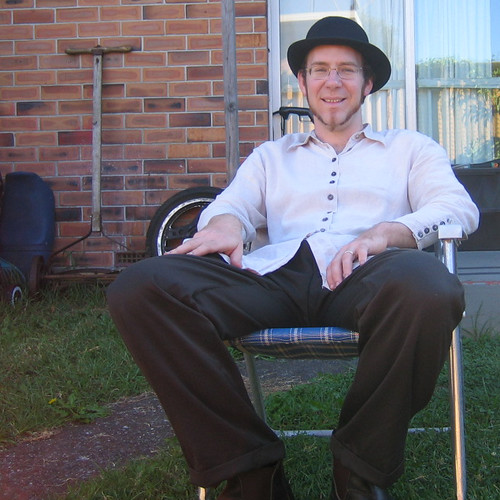
The warm weather and my recent haircut have combined to produce a new level of helmet hair, where the ventilation stripes remain clearly visible after I get off the bike. Heather has been most amused.
Wednesday, January 20, 2010

Mundo Maintenance

AS my Yuba comes up to it's 2nd anniversary, I've needed to do a bit of maintenance. Unfortunately, the final element proved challenging due to being a non-standard part (or from a very different standard).
  1. Rear tyre
    I've had two rear tyres go bad on me recently, on different bikes. Not sure what I'm doing wrong, but possibly dragging the rear end around while the tyre has little pressure? Certainly I haul the tail of the Yuba around, as its turning circle can be a bit of a pain for parking. Either way, the rear tyre started to stretch alongside the bead on one side. This was new to me, so I was slow to realise that this was the cause of a wobble on every turn of the wheel.

  2. Brake pads are wearing out faster than I expected. Possibly I'm dragging the rear brake too much?

  3. Rear Hub
    This was the doozy. I tried to adjust the cones at one point to fix the wobble from the tyre, and stuffed it up. I had already broken two rear spokes, drive side, so had to remove the cluster to replace them. (No hurry, though. With 46 of 48 spokes, the wheel still ran sweetly.)
    The rear axle is a 14mm BMX axle (grumbling tech details here), and I didn't have proper cone spanners in 19mm. I managed to approximate one spanner, but couldn't get the freewheel cluster off since my removal tool (Park Tools FR-1) doesn't fit over the 14mm axle! I ended up pulling the axle right out, taking the cluster off, replacing the ball bearings (as I lost one carrying the wheel to my friend's to use his vice), then reinstalling. Naturally, I forgot something so had to repeat. I never did get the spoke guard back on.
So that was a pain, but it has been running nicely again now. Next time I'll probably drop it into the shop for the rear hub, but hopefully that won't be for ages.

Monday, November 9, 2009

Hitchikers

Have to share: Off to a party on Saturday night, I cycled past two young lads tossing a ball back and forth on their way to the park. They spotted the Yuba's rack, and called for a lift as kids often do. For once I obliged, and carried them all of a block until our paths diverged. Don't know which of us had the biggest grin as I cycled off. :-)