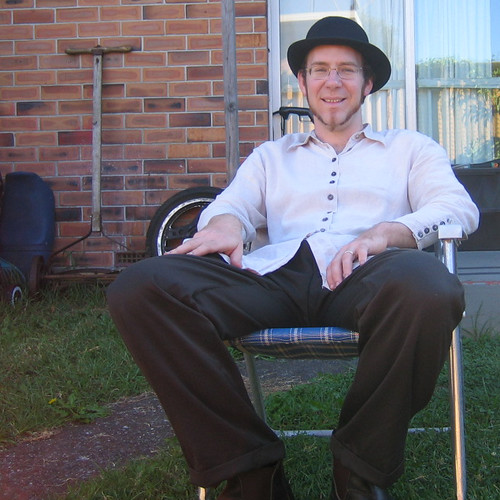
I think that's who it was who met us at the end of Critical Mass with hot samosas and a tomato-based sauce! What a great way to finish - all standing around in the cool, clear night air and chatting rather than disappearing into a noisy pub.
My dinner plans had been up in the air, so I dug in for two samosas and ate my bowl for "desert".
Friday, May 30, 2008

Sunday, May 18, 2008
Consent
Found an interesting new blog yesterday, with a great post on consent. We need more men in NZ speaking up about the practical implications of consent, in terms that show the simple humanity of the idea (and conversely how non-consensual acts deny the image of God in the other, although I doubt Ari would use those kinds of words).
Friday, May 16, 2008
Need for Speed
Yesterday I had to rush home when Heather cut her hand with a utility knife (making my birthday present!). As it worked out a neighbour drove her down to the doctor for two stitches, and I met them there. Nothing big, but she was worn out by having to make the excursion and sit up for so long in her wheelchair.
On the way home I was wishing for a speedier bike -- the Yuba may be great in general, but I was reluctant to wait for lights, let alone shop or scavenge on this trip. What I wanted was the 'Sunday Sports Car'. I have two spare bikes at work, waiting in the hope of pulling in colleagues for lunchtime rides in the Spring, and ought to set one up for the emergency sprint home. I'll probably configure the fixie with the highest gear I can manage in the homeward direction, which I would not otherwise do since that implies walking at least one section on the way back to work. (Not only is the steepest section uphill on the way in, but anytime after 10am I'm more energetic and limbered up.)
I am still considering whether I am comfortable giving up the motorbike permanently. It wouldn't have helped yesterday anyhow, as I wasn't able to predict the incident. It is good for lunchtime doctor's appointments, and late mornings when I want to get in quickly, but a speed-freak bicycle may help to mitigate the loss in those situations.
On the way home I was wishing for a speedier bike -- the Yuba may be great in general, but I was reluctant to wait for lights, let alone shop or scavenge on this trip. What I wanted was the 'Sunday Sports Car'. I have two spare bikes at work, waiting in the hope of pulling in colleagues for lunchtime rides in the Spring, and ought to set one up for the emergency sprint home. I'll probably configure the fixie with the highest gear I can manage in the homeward direction, which I would not otherwise do since that implies walking at least one section on the way back to work. (Not only is the steepest section uphill on the way in, but anytime after 10am I'm more energetic and limbered up.)
I am still considering whether I am comfortable giving up the motorbike permanently. It wouldn't have helped yesterday anyhow, as I wasn't able to predict the incident. It is good for lunchtime doctor's appointments, and late mornings when I want to get in quickly, but a speed-freak bicycle may help to mitigate the loss in those situations.
Tuesday, May 13, 2008
El mundo - mi perla
 So last month I finally received my new Yuba Mundo after months of waiting, and suffered two tantalising weeks to building it up. Since then I have taken it camping, bought a sack of rice, and commuted every day.
The big rack looks wide from behind, and gets such respect from cars that I plan to retire my blond wig. In reality it is no wider than the handlebars, so I can still fit through the same gaps. You do have to avoid cutting across the front of a car before you've actually passed into the gap, given the extra length. The maneuvreability is really noticeable with a moderate load of 10-20kg; where my old tourer would have become whippy in the tail, this monster truck rides just like normal.
"Monster truck" I said, but clown-mobile is more how I felt the first week. The whole bike is so big and heavy that you feel ludicrous without oversized boots and a giant red nose. Then you become familiar with the commanding presence on the road. You learn to carry momentum into hills, and settle into the steady rhythm of gearing suitably low for the Mundo's immensity. You learn that you can pick up those extra items at the supermarket, without worrying whether the panniers will fit them or regretting leaving the trailer at home. Then you learn that the load doesn't stop you climbing the hill between stationary lanes of traffic to position for the right hand turn towards home.
For Critical Mass last month I rode the Yuba. One of the ubiquitous fixies had a puncture, and I offered him a ride. He sat on the carrier, and held his front wheel off the ground so that the bike trailed after us. We had to trade off a couple times, as much because it was hard work holding the bike at arm's length, and we walked the last part of the major climb out of town. This was my first real load, and I was pleased with the handling. We wobbled drunkenly for a moment at the low speed of initial movement and just before stopping. In between we were pretty stable. Sadly, although many pictures were taken none seem to have reached the Flickr group and I wait until this month's ride to ask
Friday, May 9, 2008
"Car" Camping
Safe in my hammock, with the fly keeping out the rain, I foolishly assumed myself safe from the weather...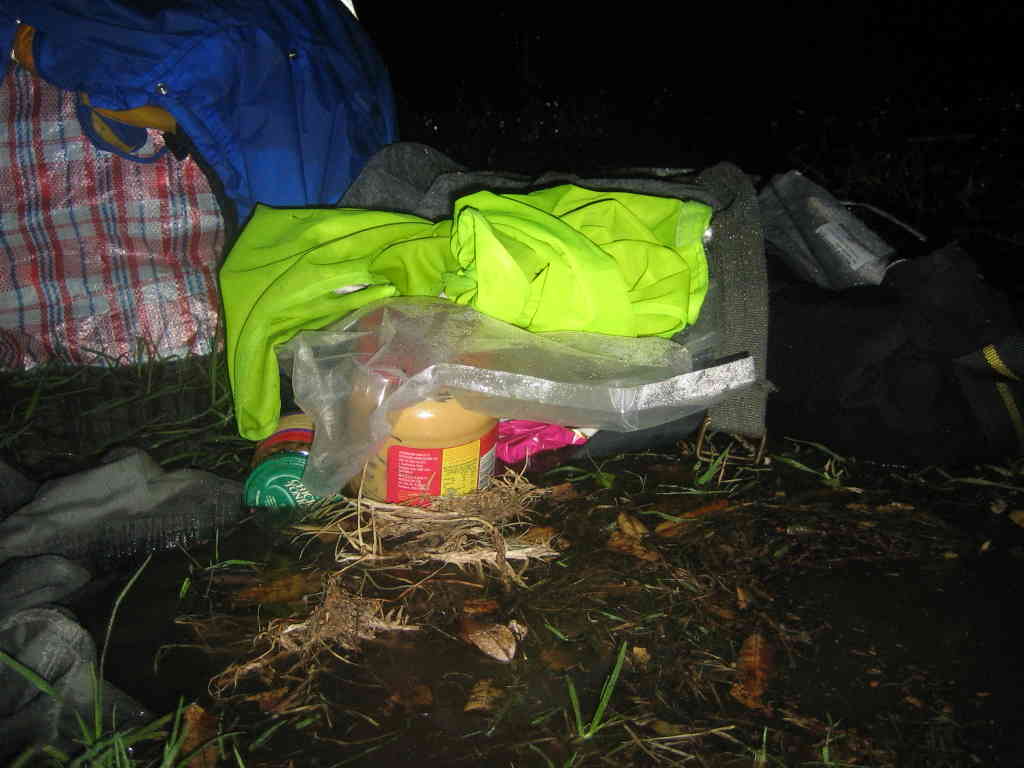 Lesson learned: hang your luggage, or pick a campsite that won't flood!
A couple of weekends back I was able to take a respite break and went camping in Shakespear1 Park, Whangaparaoa. I needed to rest more than ride, and desired an excusion just far enough to test out my new bike and newish hammock. Shakespear worked well because there's a ferry to Gulf Harbour, after which you only have to ride 7km to the very end of the peninsula. Until you reach the park itself you are in residential neighbourhoods, and there would be sufficient hostelry if I had to bail out.
Lacking time to pack tidily and efficiently, I just threw an oversupply of clothes into one of those cheap woven-plastic bags and strapped it on the yuba. 16kgs on one side and about 3 on the other, but it rode surprisingly well. I love the simplicity of this bike. Although this was the last weekend of school holidays, the weather has recently turned cold in NZ so few people were in the park. Probably a wise choice by everybody else, as it rained about 1 in every 2 hours from Friday night until Sunday morning. The last night was particularly fierce, and I realised about midnight that I had been flooded out. Thankfully I'd used separate plastic bags inside the large carry-all, not trusting it2, and nothing essential got damaged before I rescued it onto the rack of the bike (under its own tarpaulin).
The only damage done was to my breakfast :-( and a fixable rip in my bug netting when I turned around too vigorously inside the hammock and dragged the corner of my air mat across it.
Despite the rain, I was able to open out the fly during the day and make a comfy campsite. I made a good start on my current reading project, mostly sitting in the hammock and resting my foot on the gas bottle.
 I must confess that the bottle was not part of my original luggage - the friendly ranger lent it to me after we got talking about bicycles and eventually it came up that I had mis-understood the level of cooking facilities described on the council's website. That bike got me into a lot of conversations, actually -- must get some business cards or something from Stu.
All in all, a good trip. Got more familiar with my gear, and look forward to taking it on a more adventurous journey. I do need to find some kind of cooking solution - exactly what depends somewhat on whether I expect to retain the voluminous storage of the yuba or choose a smaller bike for longer trips. I also need to find a bit more insulation for my feet - they stuck off the end of the insulating mat and that hammock was quite cold on my un-insulated parts.
1) (No, there isn't supposed to be an 'e'.)
2) Actually, the cheap bag was pretty shower proof. I was impressed.
Lesson learned: hang your luggage, or pick a campsite that won't flood!A couple of weekends back I was able to take a respite break and went camping in Shakespear1 Park, Whangaparaoa. I needed to rest more than ride, and desired an excusion just far enough to test out my new bike and newish hammock. Shakespear worked well because there's a ferry to Gulf Harbour, after which you only have to ride 7km to the very end of the peninsula. Until you reach the park itself you are in residential neighbourhoods, and there would be sufficient hostelry if I had to bail out.
Lacking time to pack tidily and efficiently, I just threw an oversupply of clothes into one of those cheap woven-plastic bags and strapped it on the yuba. 16kgs on one side and about 3 on the other, but it rode surprisingly well. I love the simplicity of this bike.
Although this was the last weekend of school holidays, the weather has recently turned cold in NZ so few people were in the park. Probably a wise choice by everybody else, as it rained about 1 in every 2 hours from Friday night until Sunday morning. The last night was particularly fierce, and I realised about midnight that I had been flooded out. Thankfully I'd used separate plastic bags inside the large carry-all, not trusting it2, and nothing essential got damaged before I rescued it onto the rack of the bike (under its own tarpaulin).The only damage done was to my breakfast :-( and a fixable rip in my bug netting when I turned around too vigorously inside the hammock and dragged the corner of my air mat across it.
Despite the rain, I was able to open out the fly during the day and make a comfy campsite. I made a good start on my current reading project, mostly sitting in the hammock and resting my foot on the gas bottle.
I must confess that the bottle was not part of my original luggage - the friendly ranger lent it to me after we got talking about bicycles and eventually it came up that I had mis-understood the level of cooking facilities described on the council's website. That bike got me into a lot of conversations, actually -- must get some business cards or something from Stu.All in all, a good trip. Got more familiar with my gear, and look forward to taking it on a more adventurous journey. I do need to find some kind of cooking solution - exactly what depends somewhat on whether I expect to retain the voluminous storage of the yuba or choose a smaller bike for longer trips. I also need to find a bit more insulation for my feet - they stuck off the end of the insulating mat and that hammock was quite cold on my un-insulated parts.
1) (No, there isn't supposed to be an 'e'.)
2) Actually, the cheap bag was pretty shower proof. I was impressed.
Sunday, April 13, 2008
Nuvinci - Riding Report
Overview
I have been very happy with my NuVinci hub over the two months it has been my regular ride. Continuous shifting works well on steady or slowly-changing slopes, although I have not (yet?) developed a feel for wide shifts on sharp dips and rises. The low maintenance and simplicity are a real plus, and the wide range has worked well for commuting and grocery hauling. The weight will put off any racer, but as a commuter and utility cyclist I only notice on my most sluggish days (and could do with burning the extra calories). I have lent the bike to several novice riders who found it intuitive to use.
Sorry that this post is very long, and lacks pictures, but I wanted to lay out the details as best I can in case somebody else there is making purchase decisions. Hopefully my experience will settle your qualms about an adventurous purchase.
General Feel
The hub has provided a simple and reliable ride to and from work. It doesn't feel unique any more, although when I lent it out last week it was a bit restricting to return to big jumps between gears. I never felt that the drive was 'inefficient', however that is measured.
The hub is certainly heavy, but I don't usually notice its weight until I come to park and try to lift the tail closer to the wall. The whole bike is fairly heavy, actually, but I don't swap regularly to provide a contrast and presumably just burn a few more calories on the (fixed length) commute.
I had read that changing gears required easing off on the pedals, but I find this ceases to be a problem if my cadence is over about 70rpm. Perhaps more powerful riders would find this more of a problem, but once I get into spinning rather than grinding mode the gears move quite easily. There is a risk that I overestimate the ratio I can take through a rise, as once I am in too high a gear and pressing harder on my pedals it does become difficult to change down. I did find that adjusting the cable tension helped a bit with smoothing out the adjustment - there is a balance to find between too tight to pull at all and so loose that the controller plays quite a distance before pulling. I couldn't find an obvious sweet spot and the feel varies slightly day to day, but wherever I settled seems to be working now.
Having continuous gearing has helped me to work on my cadence after a bad year in that respect. I have tweaked a cheap computer to show me how I'm doing, and am slowly increasing my average. Unfortunately the old bike I've thrown the new wheel onto doesn't encourage fast spinning by its geometry.
The 350% range allows me to pull a trailer of groceries home (and light trailers on the steeper route to work), but still gives me just enough speed to feel safe on my commute. I am running 36:17 rings, which works out to about 6km/h at 45rpm in low gear and 46km/h at 100rpm in top. My most important downhill runs from 35-45 when congested, so I only fail to keep up if the cars are accelerating into space (such as after traffic lights). (Btw, this is close to the lowest permitted ratio (2:1), so I don't think that the hub (as rated) is ready for really heavy hauling like a rickshaw.)
Continuous Shifting
Adjusting to the new gearing was very easy -- perhaps the hardest part was turning the my wrist in the opposite direction to the friction shifters I had been using. I was certainly tentative about finding the right setting at first, but am now confident of my feel for it.
On flat road or steady climbs the smooth gearing allows you to steadily build speed and intensity. If I lose my cadence at the start of a rise (not uncommon) then I can regroup at a lower ratio and smoothly adjust the ratio as I power up. Similarly, I can ease off the gearing to retain my rhythm as the slope outlasts my energies.
This is all great when I'm fired up for my ride, but on the down days it probably lets me slack off somewhat - slowly easing down the ratio just when I ought to be pushing into the challenge. I should only bottom out the gearing at two places on my ride, but am periodically surprised how far I've let the gearing drift down. Since I don't watch the indicator most of the time, it is easy to get out of sync with my actual position in the range of adjustment.
One part of my commute crosses a series of short ridges, and I find it hard to shift very quickly. The long overall travel (over a full turn of the controller, which is well past what my wrist can do in one go) and the loose awareness of the absolute adjustment at any time mean that I can't just shift to a known setting. Stepped gearing, with it's limited options, is therefore simpler when you want to crash through several gears.
Two factors do mitigate rapid shifts. At the bottom of a dip, pedalling difficulty steadily increases. This keeps plenty of pressure on the pedals, providing more information to find the right gear. So long as you keep up or ahead of the required change then you're good. If you loosen up too much then you will lose speed but can regroup and rebuild as described above. This is annoying, but not the end of the world if you're focussed on getting places simply rather than in the zone of the ride itself. At the other end of the scale, when I crest these particular rises and drop into the next dip I have gravity assisting me if I don't get into a faster gear as soon as I'd like.
One last shifting context of note is rising out of the saddle. I am slowly learning to ease up the gear from a half-standing posture which allows me to hold high torque across an intersection. I rarely rise out of my saddle on hills, and the first few times I tried it was hard to twist my wrist on the controller while I had more reliance on my hands for riding. Once again, this isn't such a problem for more leisurely cyclists.
Robustness
Two months isn't long on this count, but the hub hasn't seemed to slip or give any kind of trouble. No maintenance is required on the hub itself -- I haven't even oiled the chain, which is probably a bit cruel even on a straight chain line. Despite a couple of heavy loads and slopes that pushed my legs to their limit in low gear, the hub never slipped. There was one curious feature, though: the rear cog still spins a bit when I freewheel, so when I restart pedalling the takeup isn't always quite where I expect it. The external freewheel is supposed to eliminate exactly this issue, so perhaps mine just needs a bit more lube?
I've dropped the wheel off a few kerbs, and even around a couple kms of off-road track (WARNING - not covered by the warranty!) . The biggest risk evident so far is that the heavy hub lands with quite a thump and needs a strongly built wheel and fat tyres or suspension for even small drops.
I have managed to damage one element - the indicator is a bit scratched up from flipping the bike over to fix punctures. Since it sticks up way above the handlebars, the indicator is always going to be a point of contact during roadside repairs.
Novice Riders
My major hope for the hub was that it would be easy for novices to pick up. I've lent the bike to a few colleagues who hadn't ridden bikes since their teens but joined a recent series of lunchtime rides to picnic at the beach. They had no trouble other than hauling the extra weight back up the hill, and were certainly mixing up the gears a lot. They still had some trouble picking the right gear, tending to spin out on uphills instead of settling in to the work. When somebody didn't change down in time they were able to stop, changed down, and restart.
By contrast, two guys on derailleur gears were discovered to be riding the same gear the whole trip. They got the idea of the rear gears fairly quickly, but avoided changing the front ring and therefore heavily reduced their range.
My flatmate, Sarah, took the bike out having not ridden for about 20 years. She picked the gearing up immediately. The only question she asked, once we had gone down and up the big dip in our street and were working uphill on the main road, was whether the cadence she had naturally settled at was 'proper'. It felt slightly fast to her, but was working smoothly, and turned out to be a tidy 65rpm.
Reccomendations
I would strongly recommend this hub to utility cyclists if you are buying new kit, or find one cheaply second-hand. If you're buying new then it's not that expensive, but there's so much good stuff being thrown out that I would encourage people to use that instead. If you've been wistfully dreaming of a Rohloff, then give this one a thought.
If you're putting a commuter bike together for a friend who is new at cycling then Nuvinci would be a great bet. The weight may deter an unfit rider in hilly areas, but give them an old beater until they've demonstrated some commitment and built up some stamina. The heavy hub on a new bike is no worse than riding an older bike with heavy frame.
Hopefully there'll be enough purchasers to keep the company going until they can make a smaller, lighter version and the wider market discovers them. (I fear, however, that the fools who disdain re-cycled gear will lack the sense to buy this nice piece of technology because they think it isn't racy enough.) The technology clearly has promise for electric bikes, and the unicyclist community would kill for a fixed version.
I have been very happy with my NuVinci hub over the two months it has been my regular ride. Continuous shifting works well on steady or slowly-changing slopes, although I have not (yet?) developed a feel for wide shifts on sharp dips and rises. The low maintenance and simplicity are a real plus, and the wide range has worked well for commuting and grocery hauling. The weight will put off any racer, but as a commuter and utility cyclist I only notice on my most sluggish days (and could do with burning the extra calories). I have lent the bike to several novice riders who found it intuitive to use.
Sorry that this post is very long, and lacks pictures, but I wanted to lay out the details as best I can in case somebody else there is making purchase decisions. Hopefully my experience will settle your qualms about an adventurous purchase.
General Feel
The hub has provided a simple and reliable ride to and from work. It doesn't feel unique any more, although when I lent it out last week it was a bit restricting to return to big jumps between gears. I never felt that the drive was 'inefficient', however that is measured.
The hub is certainly heavy, but I don't usually notice its weight until I come to park and try to lift the tail closer to the wall. The whole bike is fairly heavy, actually, but I don't swap regularly to provide a contrast and presumably just burn a few more calories on the (fixed length) commute.
I had read that changing gears required easing off on the pedals, but I find this ceases to be a problem if my cadence is over about 70rpm. Perhaps more powerful riders would find this more of a problem, but once I get into spinning rather than grinding mode the gears move quite easily. There is a risk that I overestimate the ratio I can take through a rise, as once I am in too high a gear and pressing harder on my pedals it does become difficult to change down. I did find that adjusting the cable tension helped a bit with smoothing out the adjustment - there is a balance to find between too tight to pull at all and so loose that the controller plays quite a distance before pulling. I couldn't find an obvious sweet spot and the feel varies slightly day to day, but wherever I settled seems to be working now.
Having continuous gearing has helped me to work on my cadence after a bad year in that respect. I have tweaked a cheap computer to show me how I'm doing, and am slowly increasing my average. Unfortunately the old bike I've thrown the new wheel onto doesn't encourage fast spinning by its geometry.
The 350% range allows me to pull a trailer of groceries home (and light trailers on the steeper route to work), but still gives me just enough speed to feel safe on my commute. I am running 36:17 rings, which works out to about 6km/h at 45rpm in low gear and 46km/h at 100rpm in top. My most important downhill runs from 35-45 when congested, so I only fail to keep up if the cars are accelerating into space (such as after traffic lights). (Btw, this is close to the lowest permitted ratio (2:1), so I don't think that the hub (as rated) is ready for really heavy hauling like a rickshaw.)
Continuous Shifting
Adjusting to the new gearing was very easy -- perhaps the hardest part was turning the my wrist in the opposite direction to the friction shifters I had been using. I was certainly tentative about finding the right setting at first, but am now confident of my feel for it.
On flat road or steady climbs the smooth gearing allows you to steadily build speed and intensity. If I lose my cadence at the start of a rise (not uncommon) then I can regroup at a lower ratio and smoothly adjust the ratio as I power up. Similarly, I can ease off the gearing to retain my rhythm as the slope outlasts my energies.
This is all great when I'm fired up for my ride, but on the down days it probably lets me slack off somewhat - slowly easing down the ratio just when I ought to be pushing into the challenge. I should only bottom out the gearing at two places on my ride, but am periodically surprised how far I've let the gearing drift down. Since I don't watch the indicator most of the time, it is easy to get out of sync with my actual position in the range of adjustment.
One part of my commute crosses a series of short ridges, and I find it hard to shift very quickly. The long overall travel (over a full turn of the controller, which is well past what my wrist can do in one go) and the loose awareness of the absolute adjustment at any time mean that I can't just shift to a known setting. Stepped gearing, with it's limited options, is therefore simpler when you want to crash through several gears.
Two factors do mitigate rapid shifts. At the bottom of a dip, pedalling difficulty steadily increases. This keeps plenty of pressure on the pedals, providing more information to find the right gear. So long as you keep up or ahead of the required change then you're good. If you loosen up too much then you will lose speed but can regroup and rebuild as described above. This is annoying, but not the end of the world if you're focussed on getting places simply rather than in the zone of the ride itself. At the other end of the scale, when I crest these particular rises and drop into the next dip I have gravity assisting me if I don't get into a faster gear as soon as I'd like.
One last shifting context of note is rising out of the saddle. I am slowly learning to ease up the gear from a half-standing posture which allows me to hold high torque across an intersection. I rarely rise out of my saddle on hills, and the first few times I tried it was hard to twist my wrist on the controller while I had more reliance on my hands for riding. Once again, this isn't such a problem for more leisurely cyclists.
Robustness
Two months isn't long on this count, but the hub hasn't seemed to slip or give any kind of trouble. No maintenance is required on the hub itself -- I haven't even oiled the chain, which is probably a bit cruel even on a straight chain line. Despite a couple of heavy loads and slopes that pushed my legs to their limit in low gear, the hub never slipped. There was one curious feature, though: the rear cog still spins a bit when I freewheel, so when I restart pedalling the takeup isn't always quite where I expect it. The external freewheel is supposed to eliminate exactly this issue, so perhaps mine just needs a bit more lube?
I've dropped the wheel off a few kerbs, and even around a couple kms of off-road track (WARNING - not covered by the warranty!) . The biggest risk evident so far is that the heavy hub lands with quite a thump and needs a strongly built wheel and fat tyres or suspension for even small drops.
I have managed to damage one element - the indicator is a bit scratched up from flipping the bike over to fix punctures. Since it sticks up way above the handlebars, the indicator is always going to be a point of contact during roadside repairs.
Novice Riders
My major hope for the hub was that it would be easy for novices to pick up. I've lent the bike to a few colleagues who hadn't ridden bikes since their teens but joined a recent series of lunchtime rides to picnic at the beach. They had no trouble other than hauling the extra weight back up the hill, and were certainly mixing up the gears a lot. They still had some trouble picking the right gear, tending to spin out on uphills instead of settling in to the work. When somebody didn't change down in time they were able to stop, changed down, and restart.
By contrast, two guys on derailleur gears were discovered to be riding the same gear the whole trip. They got the idea of the rear gears fairly quickly, but avoided changing the front ring and therefore heavily reduced their range.
My flatmate, Sarah, took the bike out having not ridden for about 20 years. She picked the gearing up immediately. The only question she asked, once we had gone down and up the big dip in our street and were working uphill on the main road, was whether the cadence she had naturally settled at was 'proper'. It felt slightly fast to her, but was working smoothly, and turned out to be a tidy 65rpm.
Reccomendations
I would strongly recommend this hub to utility cyclists if you are buying new kit, or find one cheaply second-hand. If you're buying new then it's not that expensive, but there's so much good stuff being thrown out that I would encourage people to use that instead. If you've been wistfully dreaming of a Rohloff, then give this one a thought.
If you're putting a commuter bike together for a friend who is new at cycling then Nuvinci would be a great bet. The weight may deter an unfit rider in hilly areas, but give them an old beater until they've demonstrated some commitment and built up some stamina. The heavy hub on a new bike is no worse than riding an older bike with heavy frame.
Hopefully there'll be enough purchasers to keep the company going until they can make a smaller, lighter version and the wider market discovers them. (I fear, however, that the fools who disdain re-cycled gear will lack the sense to buy this nice piece of technology because they think it isn't racy enough.) The technology clearly has promise for electric bikes, and the unicyclist community would kill for a fixed version.
Tuesday, March 4, 2008
When will we Get Across?
It looks like there's a big campaign coming for cycle and pedestrian routes over the Harbour Bridge. I can't make the launch tomorrow, but hope to get a t-shirt or something to parade around town. They'd have sold a bunch if they'd had them at Critical Mass.
This has been tried before - hopefully the time and public mood are right. I don't think that our beloved mayor will be a fan.
This has been tried before - hopefully the time and public mood are right. I don't think that our beloved mayor will be a fan.
Subscribe to:
Posts (Atom)